
Flax and the Heart of Mary - The Hidden Thread of Silence and Spiritual Strength

Updated: Jun 3
Flax and the Heart of Mary
Have you ever held flax in your hand?
It feels sharp, ordinary, almost unremarkable - until it is broken, softened, and spun into thread. Sometimes that thread becomes a simple, rough fabric; other times it turns into something delicate and beautiful.
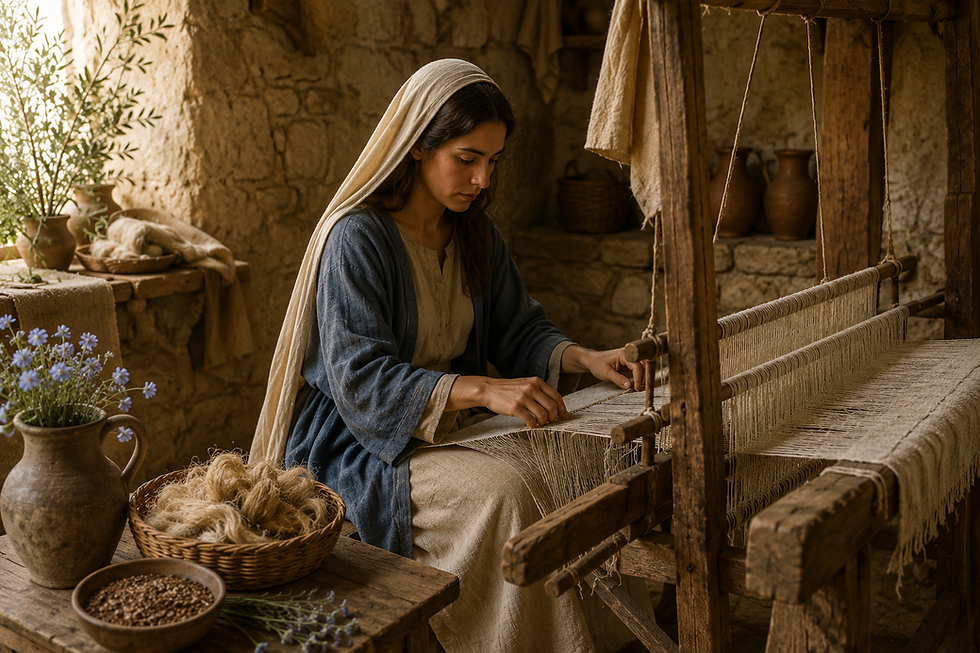
It reminds me of how God works in our lives: through patience, struggle, and transformation, He forms something good within us. It also reflects, in a quiet way, the depth of Mary - Her simplicity, humility, and the beauty hidden in ordinariness.
In biblical times, flax symbolized work, patience, and purity. It was used to make priestly garments, curtains of the sanctuary, and burial cloths. But before it became something sacred, it had to be soaked, broken, and combed. In a sense, it had to “die” to itself.

Mary, the Mother of God, is like this flax - hidden in the simplicity of everyday life, clothed in humility, entirely surrendered to God’s will. It was precisely in this mystery that Heaven found its resting place. Her “yes” - Her Fiat - began weaving the most sacred garment of all: the Incarnation, clothed in human flesh.
When I look at a field of flax, I think of Mary’s Heart. Flax and the Heart of Mary - delicate, yet strong, intertwined in a silent offering that gives life and transforms the world. Isn’t it beautiful? Can you take your eyes off it?

The Hidden Thread 🌿
In early Christian thought, flax also symbolized purity of intention, quiet work, and preparation for holiness. Just as linen fabric is formed in silence and effort, so Mary was shaped in Nazareth and in the Temple - in hiddenness, holiness, and everyday life. She became a dwelling place not made by human hands, but hidden among the quiet inhabitants of a Galilean village.
She is a model of fruitfulness - allowing God to spin the thread of His plan through her willing openness, rather than through her own striving.
She shows that it is not our abilities that are the key, but the readiness of the heart. God works through her openness, not through her activity.
A Spiritual Connection 🌿
In Scripture, linen is often associated with righteousness:
“Let justice roll on like a river, righteousness like a never-failing stream.” Amos 5:24
Mary did not wear priestly robes, yet she was clothed in an interior purity—like the most beautiful garment, woven from grace and humility. The angel greeted her with the words: “Full of grace.”
Like flax, she was prepared to receive the Word and weave It into the story of humanity.
My Own Hidden Thread 🌿
How do I allow God to soften my heart?
Am I like flax that, before becoming thread, must be broken, soaked, stretched in His hands - so that it can become useful? A thread that endures, connects, and supports?
This is a process both painful and sacred.
Like Mary, I am learning to say my “yes” not when I understand everything, but precisely when the unknown knocks at the door of my life. When the path is still formless, and light is hidden in the fog of faith, I choose trust. When uncertainty causes trembling, and the road has no shape yet, my “yes” matures in silence like a seed underground, like flax in the hands of the Weaver.
In a world that constantly encourages us to speak more, show more, and be more visible, I increasingly find peace in a simple, quiet life—in the forest, in the song of birds, in the work of my hands, in the scent of flax, and in ordinary days lived close to God and nature.
I am learning that what is most important does not need to be seen by others. Time spent in prayer, baking bread, tending a garden, or walking in silence gives me more life than constant rush and noise. In this simplicity and obedience to what is quiet, invisible, and eternal, my heart is truly renewed.
Spiritual Journaling 🌿
To respond to deep and difficult questions, I have long chosen journaling.
Writing down thoughts, prayers, questions, gratitude, and spiritual experiences is a form of prayer itself, a meeting with the Father, Abba, who hears me and cares for me and “satisfies all my needs.” It is more than a diary. It helps me notice how God acts in everyday life, even in small and seemingly ordinary moments.
Sometimes I write down Scripture passages, reflections after prayer, struggles, desires of the heart, or things I am grateful for that day.
It matters. When I write, I can more easily see my emotions, recurring thoughts, and spiritual longings. Over time, I can notice how my heart has changed, how prayers were answered, or how God guided me through difficult seasons.
Journaling also teaches attentiveness and simplicity. Instead of constantly seeking new stimuli, I begin to notice daily life more deeply: morning silence, birdsong, peace after prayer, a single Gospel verse that remains in my heart all day. It builds a deeper relationship with God and with myself, helping me live more consciously in the present moment.
Reflection 🌿
My reflections often become a form of prayerful journaling:
📌 What is God preparing in me that I do not yet see?
“God accomplishes His deepest work in silence.” – St. John of the Cross
📌 Where do I resist the process of being softened like flax?
“The soul cannot live without love. It must love something, because it was created for love.” – St. Catherine of Siena
📌 What would my own “yes” look like today?
“Let it be done to me according to Your word.” – Mary (Luke 1:38)
Daily Prayer for Spiritual Growth🌿
Mary - Miriam of linen strength, teach me the beauty of silent sacrifice.
Mary - Miriam with eyes the colour of sky and flax, transform my heart into yours.
Wrap it in a wreath of purity, adorned with virtues like herbs woven into a festive crown.
Take my heart, beloved Mother, consecrate it as yours.
Present it to God, our Father, as my offering given to you.
Help me, O Mary - Miriam in a garment the colour of flax blossoms, to make your Heart known more each day.
Lord, transform my heart into a thread of love strong like flax fibre, though hidden. Break my resistance, soak me in Your silence, stretch me in the hands of Your will. Let my life become a “yes” that endures even when I do not understand. Amen.
“Do not ask for the path, let yourself be led.” – Jesus to Alicja Lenczewska
🌿 Flax - Small Wonders of Creation
Flax blooms between June and July. Its flowers open early in the morning and… fade the very same day! Yet the plant produces so many of them that a field of flax looks like a blue ocean for several days.
It is usually harvested in August, before the seeds fully ripen. The entire plant is pulled out with its roots intact, essential for obtaining long fibres.
Why is flax so important?
One of the oldest cultivated plants, known since ancient Egypt
Its fibres produce linen fabric, valued for durability, coolness, and natural texture
Its seeds (linseed) are rich in fibre, omega-3 fatty acids, and lignans
It is eco-friendly, requires no chemicals, and the whole plant can be used
Symbolically, flax represents purity, simplicity, and quiet growth. It grows modestly, yet offers great usefulness - much like saints living ordinary lives.
🥄 Flax in food and health
🌱 Linseed (flax seeds)
They soothe the digestive system - helping with reflux, ulcers, and constipation. They are rich in fibre (supporting digestion), omega-3 (anti-inflammatory), and lignans (hormonal and potentially anti-cancer effects). They gently cleanse and support gut flora.
🌱How to use them
Ground fresh, they can be added to oatmeal, smoothies, bread, yogurt, or soups. When mixed with water, they form a natural gel that can be drunk or used as an egg substitute in baking. Flaxseed jelly is a traditional natural remedy - simply pour hot water over seeds and let them swell, preferably overnight.
🌱 Flaxseed oil
Cold-pressed and unrefined, with a golden colour and strong flavour. Rich in omega-3 (ALA), supporting the heart, brain, and immunity. Never heat it; it's best used cold in salads, cottage cheese, or vegetables. It was a key element in Dr. Budwig’s dietary approach.
It is also a natural cosmetic - moisturizing skin, soothing inflammation, and strengthening hair.

🌸 Final invitation
Take a quiet walk.
August 15th, the Feast of Our Lady of Herbs, is one of the oldest Marian celebrations. On this day in Poland, herbs, grains, and flowers are blessed in church.
In folk tradition, Mary is honoured as the Guardian of harvests and gardens. We offer her what the earth has given and what has grown in our hearts: gratitude, hope, and longing for holiness.
Let Mary, Mother full of grace, teach us to see God in what is small, quiet, and ordinary, like flax flowers, like a blade of grass, like a whisper of prayer, like everyday life woven with love.
Walk with Her. With a bouquet of herbs in your hand and an open heart, follow the One who listened before she spoke. Perhaps in the scent of mint and chamomile, in the silence of fields and gardens, you will hear something meant only for you…
🌸 Learn how Mary can help grow you in love:
🌸💖 If this reflection has touched your heart, share it with a friend or loved one, and let’s grow in love together! 💖🌸


Comments